I’ve been thinking about uncertainty a fair bit lately. I’m working away at the findings section of my thesis, digging into feedback on drafts created a couple of years ago, and remembering the feeling of wheelspinning in thick, thick mud. There’s a lot of advice out there about trusting the process and writing your way through the difficulty, but every time, I find myself impatient. I will not trust the process. I will not write my way through the difficulty. Instead, I will look at the thoughts scattered across the page, some red text here, some green there, some of it highlighted, some with angry comments to the side saying WHAT EVEN IS THIS and WHERE AM I GOING WITH THIS?, and I will feel the old resistance.
The thing is, my research is about learning amateur craft skills, and part of the process of learning is about embracing uncertainty, and about trusting the process, and about working through the difficulty. It’s also about it being okay to try things out and deciding that they’re not worthy of further development, but knowing that that’s an important part of the creative process rather than being a waste of time. With the writing, I want the words to emerge perfectly formed, as if I knew what I wanted to say before I committed the words to the screen. I want my fingers to be able to feel their way through the materials and to know which keys to press to transform those materials into a honed object, but of course they can’t, because they don’t yet understand what form it is I’m striving for. Yes, there’s a plan, but that plan is a guide, not a set of rules to be followed. I must feel my way through, regardless of my reluctance. The craft theorist David Pye talks about the workmanship of certainty and the workmanship of risk, in which the certainty pertains to machined manufacturing where each piece is created to be identical to the next and the last, and the workmanship of risk relates to the handmade, where the intervention of the maker’s hand invites uncertainty. I’m struggling to observe that as with the experience of learning craft skills, and with the process of writing the doctoral thesis, so, too, the experience of undertaking the doctorate: that this uncertainty, this discomfort, this experience of the process is actually the point of the whole thing.
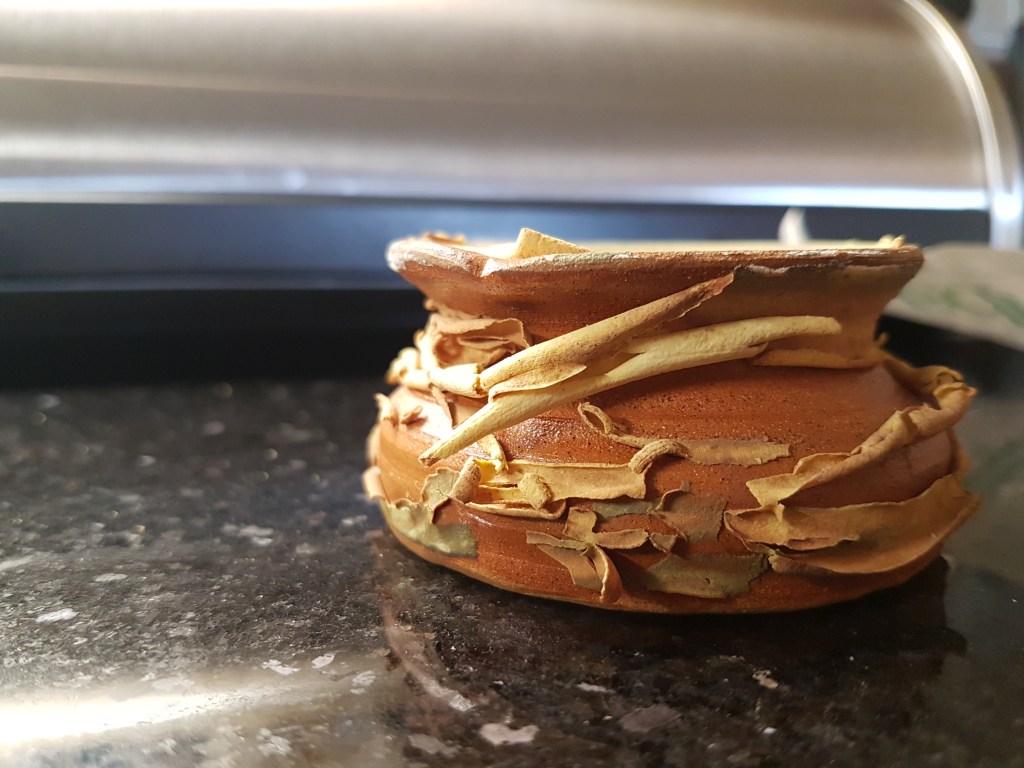
In thinking about the first steps taken in entering a craft space to begin the process of learning, I consider how this is a liminal experience, by which I mean that there is a transition, both in the very practical sense of stepping over a threshold into a space, but also in the sense of taking a risk as one steps into an unfamiliar space. This liminal position can also be a way of thinking about the odd experience of being both researcher and participant in the activity being researched, as is common in much ethnographic fieldwork; another way of thinking about it is that one is neither fish nor fowl, neither one nor the other, always hovering on the threshold of experience – in my case, in hindsight, I see how hard it was to hold both positions, unable to put one or other self down for fear of tipping the balance and being unable to right myself.
The real point of this post: within my writing I seem to be striving for neat conclusions where, really, there are none. At least not neat ones anyway. During the making activities I undertook as part of my fieldwork, in a ceramics studio and a print workshop, I wanted the things I made to be ‘right’; I have a Fine Art background, I have years of creative experience behind me, so of course I didn’t want to make rubbish things; I was better than that, wasn’t I? Reader, I made rubbish things. I was very resistant to the whole experience though, unlike the women in one of the printmaking classes I attended who were very open to the idea that anything they produced was just part of the learning, and that their understanding of unfamiliar processes gave them new ideas to take away and apply to future work. In my resistance to what I perceived as failure, as I hovered in my liminal space ironically I failed to take the risks that I saw others taking, and as a consequence my work remained slightly forced and rather contrived. As much as I remind myself of the Stoic maxim that ‘what’s in the way, is the way’, I am reminded that a bulldozer is rarely the most appropriate tool for path-building.
As with all of this, so with the wider life context in which this research is happening: I find myself inhabiting a liminal space right now, with an uncertain future ahead; each of my frequent attempts to impose a plan to force the future in a particular direction, results in me being forced to remind myself that all that matters is the work of right now, with one foot in front of the other, and each word following the last. The conclusions in my research are around an idea of what I term ‘permission space’ (with all the affordances, constraints and power dynamics that implies), the uses of strategic learning (that is, learning enough to do the things I want to do rather than engaging in some full apprenticeship), and the process of becoming (both in relation to a developing creative identity, and in engaging fully with processes as part of learning). If I were to look closely at these not-so-neat conclusions for my writing, I might perhaps also choose to apply them elsewhere.

 Clare Daněk
This is really wonderful Clare. I love it. What great reflections. “… that this uncertainty, this discomfort, this experience of the process is actually the point of the whole thing.” — brilliant.
LikeLiked by 1 person